
UAVs, Ad-Hoc Networks, and Autonomous Control
Background and Challenges
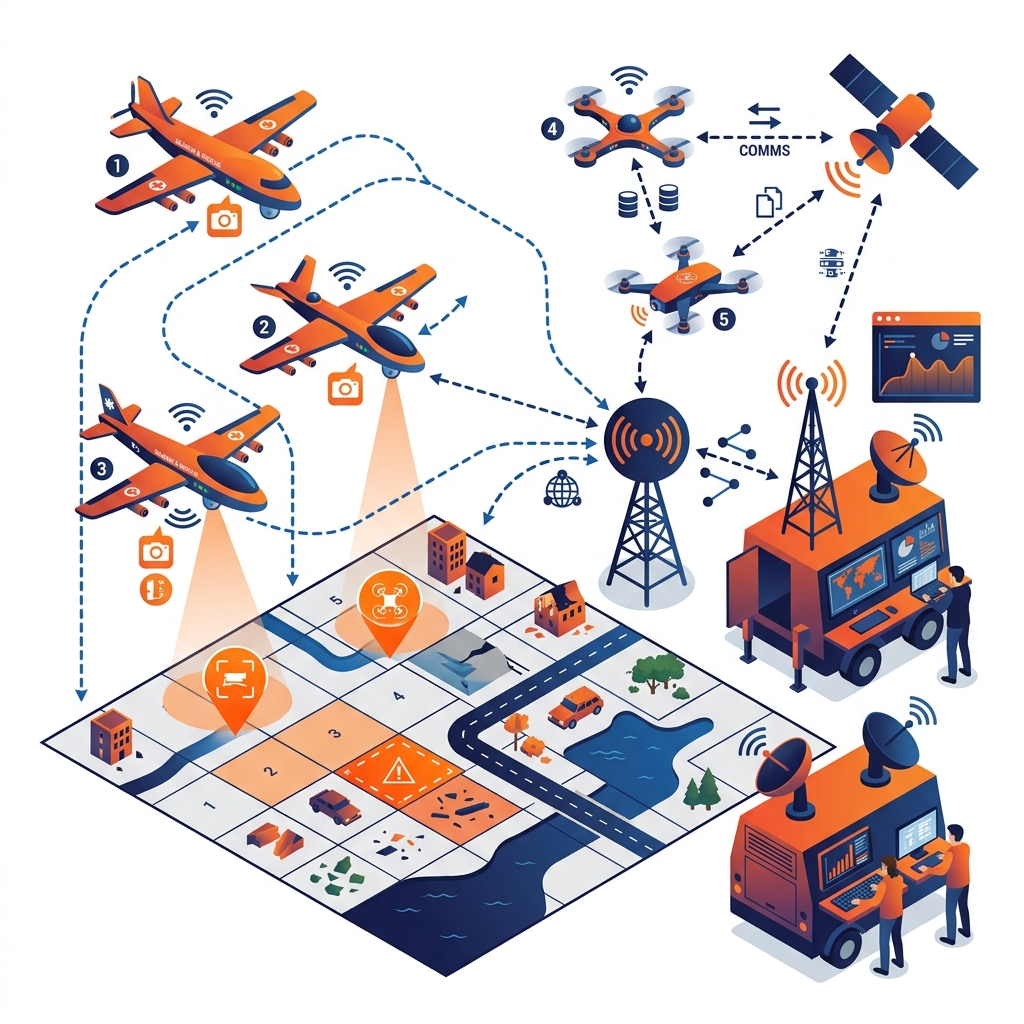
With the rapid progress in Unmanned Aerial Vehicle (UAV) technology, there is growing expectation for using drone fleets in Search and Rescue (SAR) operations in hazardous locations such as earthquake sites and mountainous regions as well as wide-area autonomous infrastructure monitoring.
However, UAVs are heavily constrained by battery capacity and sensor ranges. Furthermore, in disaster situations where public base stations and communication infrastructures are destroyed, coordinating a fleet of autonomous drones to search effectively while maintaining dynamic wireless ad-hoc networks without link disconnection remains a major challenge. Highly adaptive cooperative control algorithms are essential.
Our Approach
Our laboratory investigates distributed autonomous cooperative control algorithms combined with wireless ad-hoc networking to optimize multi-UAV operations and Wireless Sensor Networks (WSNs) in harsh environments.
1. Cooperative Path Planning for Multi-UAV Search and Rescue
We study path planning algorithms where a fleet of drones dynamically evaluates the probability of finding survivors and geographical risks across search blocks. By adopting bio-inspired locust swarming behavior and game-theoretic auction negotiation schemes, we propose decentralized movement control systems. These adaptively plan search paths to discover survivors within the critical golden hour after a disaster before survival rates drop.
2. Opportunistic Routing and Delay Tolerant Communication in Ad-Hoc Networks and FANETs
In ad-hoc networks consisting of mobile agents like drones or vehicles, we study opportunistic routing techniques that dynamically select relay nodes by exploiting the broadcast nature of wireless communications. To ensure robust data transmission against frequent link disconnections caused by node mobility or obstacles, we propose secure routing algorithms incorporating node reliability evaluations. Furthermore, in environments with inevitable long-term disconnections, we utilize delay tolerant network (DTN) technologies to temporarily store and physically carry data via node mobility. We research highly efficient disaster information gathering models that coordinate UAVs with ground sensors, as well as topology control strategies that dynamically identify and protect critical key nodes whose link failures could fragment the drone network.
3. Self-Maintenance and Security of Wireless Sensor Networks
Improving the longevity and security of ground-level sensor networks—which serve as the data sources for UAVs—is another core interest. We study wireless charging path selection based on energy consumption predictions to sustain sensor node operations. We also research security methods that dynamically detect and isolate compromised or malicious nodes based on multidimensional indicators. Additionally, we study multi-drone flight models to optimize data collection from ground WSNs.