
Intelligent Systems & Machine Learning Applications
Background and Challenges
Deep learning technology has advanced remarkably, expanding beyond image recognition and natural language processing into complex decision-making, predictive modeling, and system simulation in the real world.
Unlike "perfect information games" such as chess or Shogi where the entire state is visible to all players, "imperfect information games" such as Mahjong or poker feature hidden components like opponent hands. These require agents to make high-precision estimations and decisions under high uncertainty. Additionally, in network engineering, generating high-quality synthetic datasets that preserve the statistical properties of real network logs while protecting user privacy has become crucial for system validation.
Our Approach
Our laboratory applies cutting-edge AI architectures, such as Transformers and Generative Adversarial Networks (GANs), to build intelligent decision-making systems and high-fidelity data generation schemes.
1. Opponent Hand and Waiting-Tile Estimation in Mahjong using Transformers
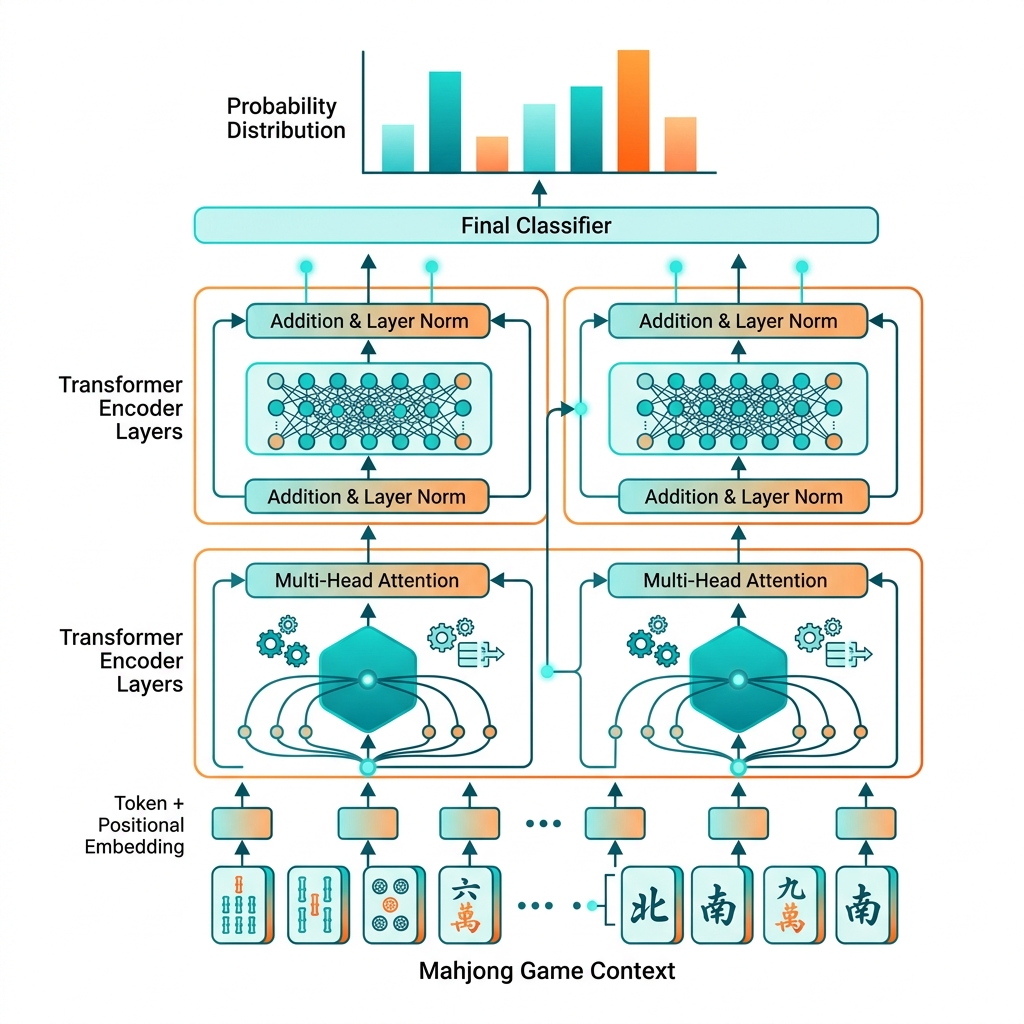
In Mahjong, we process sequential contextual information, such as the historical order of discarded tiles and opponent declarations (e.g., Pong or Chow), to dynamically estimate the probability distribution of opponent waiting tiles. By feeding temporal game-state vectors into a Transformer Encoder, our model captures the flow of the game and opponent behaviors, achieving superior Recall scores compared to traditional heuristic and frequency-based models. This approach shows significant promise for AI decision-making under uncertainty, safety assessments, and context analysis in complex dynamic environments such as VANETs.
2. Synthetic Network Traffic Generation using Tabular GANs (CTGAN)
In network security audits and simulations, sharing real traffic logs is often restricted due to privacy concerns. To address this, we leverage CTGAN to synthesize realistic, mock traffic data that mirrors the statistical characteristics of actual network flows. Specifically, by generating minority attack classes (data augmentation), we successfully improved the detection accuracy of Intrusion Detection Systems under highly imbalanced data distributions without risking the exposure of sensitive real-world records.