
Edge/Fog Computing and Next-Gen Networking
Background and Challenges
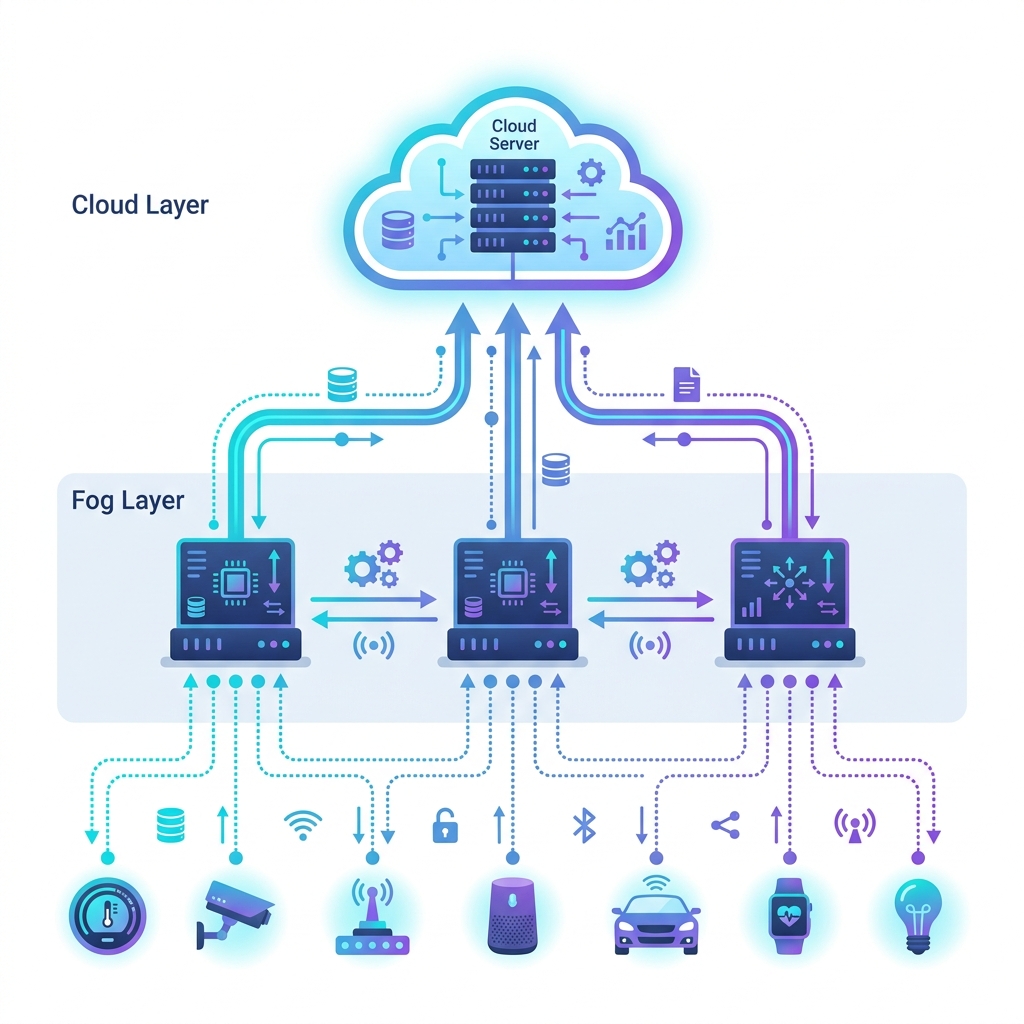
With the exponential surge in mobile traffic and the rise of ultra-low latency applications like smart cities and autonomous driving, traditional centralized cloud computing—which routes all data to remote data centers—faces severe communication congestion and critical transmission delays. To overcome these limitations, Edge/Fog computing has emerged, deploying computing resources physically closer to end-users.
However, in heterogeneous environments where various IoT devices connect via different wireless protocols such as Wi-Fi, Bluetooth, and ZigBee, several dimensional optimization challenges exist. These include how to allocate computing and network resources effectively, how to map multiple logical network requests on top of dynamic wireless multi-hop infrastructures (Virtual Network Embedding: VNE), and how to achieve sub-meter indoor terminal positioning where GPS signals are unavailable.
Our Approach
Our laboratory integrates mathematical optimization, AI models, and wireless measurement techniques to build highly efficient next-generation communication and computing infrastructures.
1. Task Offloading and Gateway Placement Optimization in Fog/MEC Environments
We study optimal designs for Edge/MEC environments to minimize end-to-end latency while reducing the power footprint of the overall infrastructure. Specifically, in Multi-Access Edge Computing (MEC), to minimize the "Total Energy Consumption", which includes both user devices and edge servers, we design task-offloading algorithms optimized via metaheuristics such as Genetic Algorithms (GAs). These dynamically decide when and where to offload specific tasks. We also develop Tabu Search algorithms for fog node placement and data-distributed offloading schemes to balance latency, cost, and reliability.
2. Virtual Network Embedding (VNE) and Opportunistic Routing in Heterogeneous Wireless Networks
We research wireless Virtual Network Embedding (VNE) algorithms, which dynamically map multiple virtual networks with distinct QoS requirements onto a single physical infrastructure. By incorporating wireless characteristics such as link quality fluctuations and packet loss delays, we optimize mapping models to maximize physical resource utilization and virtual network request acceptance rates. We also enhance Opportunistic Routing (OR) leveraging wireless broadcasting, focusing on spatial-temporal load balancing and maximizing accommodated network traffic.
3. Traffic Super-Resolution and Next-Gen Routing Control using Time-Series AI
Using coarse-grained network traffic logs collected via standard protocols such as SNMP, we apply deep learning (Transformer) models to reconstruct high-frequency packet variations and burst traffic patterns, a process known as "Traffic Super-Resolution." We also study next-generation internet protocol control, such as communication resource optimization via SRv6 source routing in multi-homed networks.
4. High-Precision Indoor Positioning combining Wi-Fi RTT and BLE Fingerprinting
We investigate indoor positioning techniques for environments where GPS signals are blocked, such as high-rise buildings and underground facilities. We study hybrid BLE Fingerprinting and Wi-Fi RTT positioning schemes. By using both RSSI and RTT measurements and optimizing reference point coordinates, we develop algorithms to minimize physical deployment overhead while achieving sub-meter coordinate estimation accuracy.